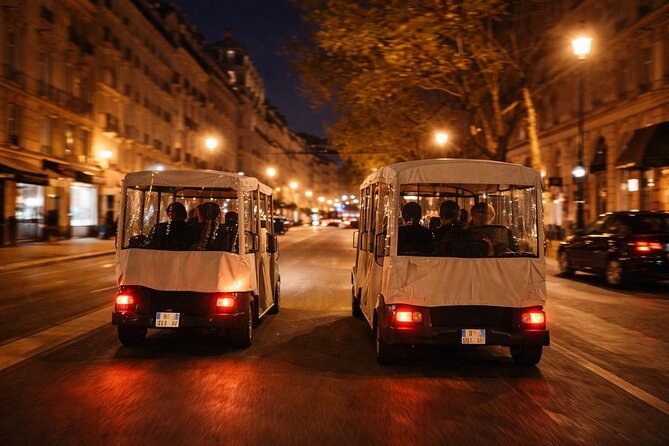
Paris by Night 2 Hour Private Golf Cart Tour
PrivateUp to 12
Open-sided and best in the warm months, private to your party, with pickup across seven central arrondissements.
From $177 per person
Because the subject is darkness, and Paris has a great deal more of it in one half of the year than the other. The city sits at 48.9°N, further north than Montreal, and its sunset swings more than five hours between the solstices.
On a daytime tour the season affects your comfort. On a night tour it affects whether the tour happens at all in the sense you booked it, because the floodlighting is triggered by light sensors and simply is not on before dusk.
| Month | Sunset | Dark enough | Book a departure at |
|---|---|---|---|
| January | 17:20 | 17:55 | 6pm or later |
| February | 18:10 | 18:40 | 6.30pm or later |
| March | 18:55 | 19:25 | 7pm or later |
| April | 20:40 | 21:15 | 8.30pm or later |
| May | 21:25 | 22:00 | 9pm or 10pm |
| June | 21:55 | 22:40 | 10pm |
| July | 21:50 | 22:30 | 10pm |
| August | 21:05 | 21:40 | 9pm or later |
| September | 20:05 | 20:35 | 8.30pm or later |
| October | 19:00 | 19:35 | 7.30pm or later |
| November | 17:10 | 17:45 | 6pm or later |
| December | 16:55 | 17:30 | 6pm or later |
Times are computed for central Paris, rounded to five minutes, and drift by a few minutes across each month. Our sunset times page carries the same figures with a paragraph on what each month is like to be out in.
Four things, and only one of them is temperature.
How long the city is lit. About eight hours on a December evening against about four in June. Winter gives you far more of the thing you came for.
When you have to start. A 6pm departure in December against a 10pm one in June, which changes what you can do before and after.
How comfortable it is. 3–8 °C in December against 15–23 °C in July, and that gap decides whether an open-top format is a pleasure or an ordeal.
How busy it is. The monuments are at their quietest between November and February and their busiest in July and August.
September. Evenings still run 13–19 °C, it is dark by about half past eight, the summer crowds have gone, and every format is comfortable. From 28 September the open-top night bus moves to its earlier 20:30 departure, which is a useful marker for when the season turns.
Late April and early October are the runners-up for the same reasons in reverse. If you are choosing dates purely for this, choose one of those three windows.
December, and it is not close. The sun is down before five, so a short cheap tour shows you everything; demand is at its lowest, so the small-group departures have space; and the Christmas illuminations are up on the Champs-Élysées and around Place Vendôme from late November.
There is also a product that runs only then. The Christmas lights tour by convertible 2CV is a seasonal listing, and it covers Place Vendôme, Avenue Montaigne and Boulevard Haussmann when they are at their best.
Anything, but late. May to August is the one window where the departure time is the whole decision, and a 9pm booking in June will run in daylight for its first ninety minutes.
The formats that work best are the ones that flex. Bateaux-Mouches sails every thirty minutes from 17:00, so you can simply take a later one. The 2CV operators will run a 9pm or 10pm departure and ask you to choose it. The open-top bus is already set to 21:30 for exactly this reason.
Something warm, or something short. A dinner cruise, a lights cruise or a private car are all comfortable at 5 °C; two hours on an open bus deck is not, and neither is three hours on a bicycle.
The other winter advantage is that a cheap short tour does the whole job. A seventy-minute cruise leaving at 18:00 in December is fully dark for its entire length, which is not true of the same sailing in June.
Almost never. The cruises, the private cars and the buses all run in rain; the bus simply closes its top; the segway and bike tours run rain or shine and hand out raincoats; the 2CV keeps its roof up.
What rain does is remove the reason you booked an open-top format. Almost everything here refunds in full up to 24 hours ahead, so the sensible move is to book, watch the forecast the day before, and move it if you need to. Our what to expect page has the detail.
From late November to early January on the Champs-Élysées, around Place Vendôme and along Boulevard Haussmann, where the department store windows are part of the attraction. It is the one time of year Paris adds to its permanent lighting rather than just switching it on.
It is also the only window in which the seasonal 2CV tour runs, and December's early sunset means you can see all of it and still be at dinner by eight.
Colder than the daytime figure, and the gap is bigger than people expect. Paris drops several degrees within an hour of sunset, so a 12 °C October afternoon is a 7 °C evening by the time a tour is running.
Add wind chill on top of that for anything open. A moving bus deck, a convertible roof or a bicycle all take several degrees off again, which is why an open-top format in February is a genuinely different experience from the same tour in June. The 2CV tours are the only ones that carry blankets, and the segway and bike tours hand out raincoats when the weather calls for it.
Between November and February, and the difference is substantial. The same evening circuit that has queues at the Trocadéro railing in July has space to set a camera down in January.
That matters more than it sounds for the free parts of the evening. Sacré-Cœur until 22:30 is a different building with forty people in it than with four hundred, and the steps below it are the best view in the city when you can actually sit on them. Our page on what stays open has the hours for the interiors worth timing this around.
Not the list price, which the operators hold steady, but it changes the value considerably. A seventy-minute cruise costs the same in December and June and delivers far more in December, because every minute of it is dark.
It also changes which format is worth paying up for. In summer the extra spent on a private car buys you comfort you do not need and a late start you have to accommodate; in winter it buys warmth, which is worth real money at 4 °C. Our night tour options page sets out which formats are warm and which are not.
They are the sharpest jumps in the year and worth knowing about if your dates fall near them. On the last Sunday in March the clocks go forward and sunset moves an hour later overnight, so a tour that was fully dark on the Saturday runs in daylight on the Sunday. The open-top night bus switches to its 21:30 departure from 30 March for exactly this reason.
On the last Sunday in October the reverse happens and the evening arrives an hour earlier. If you are booking within a few days of either date, take the departure time from the correct side of the change rather than from the month as a whole.
No month is bad, but June and July are the hardest to book well. Nothing is properly dark until 22:30 or later, which pushes a two-hour tour past midnight and rules out most of the family-friendly formats entirely. Add the July crowds and it is the one window where the evening takes real planning.
If those are your dates, the answer is a late cruise or a 2CV at 10pm rather than anything starting at eight. The sunset times page has the exact figure, and the operators that run late departures are marked on Paris Night Tours.
| If you are | Go in | Because |
|---|---|---|
| Visiting once and want it easy | September | Warm, dark by 20:35, and quiet |
| Watching the budget | December – February | Lowest demand and the longest dark |
| Booking an open-top format | May – September | It is the only comfortable window |
| Travelling with children | September or October | Dark early enough for a sane bedtime |
| Coming for the Christmas lights | Late November – early January | The only time the illuminations are up |
| Photographing the city | October or February | Long blue hour, clear air, no crowds |
Whichever month you land in, the departures that actually run at that hour are on Paris Night Tours, and the decision guide narrows the format.
Open-sided and best in the warm months, private to your party, with pickup across seven central arrondissements.
From $177 per person
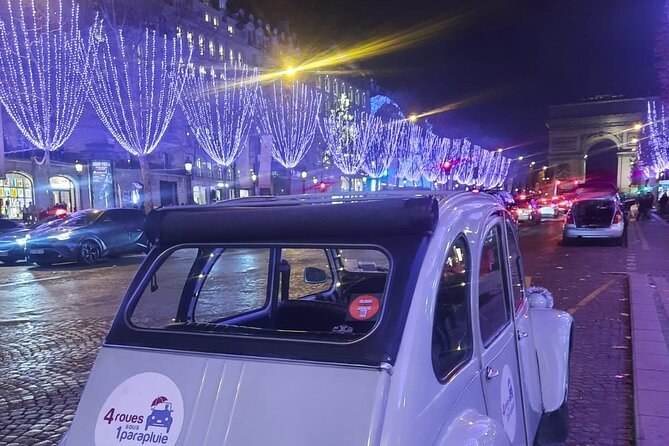
The seasonal one, running under the December illuminations and charged per car for up to three passengers.
From $270 per group of up to 3
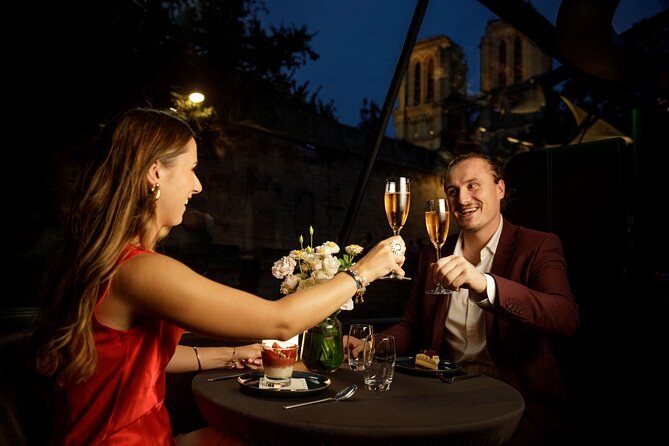
Glass-sided and heated, which makes it the format that works identically in January and July.
From $147 per person
Got your month? The sunset times page turns it into a departure time, month by month.