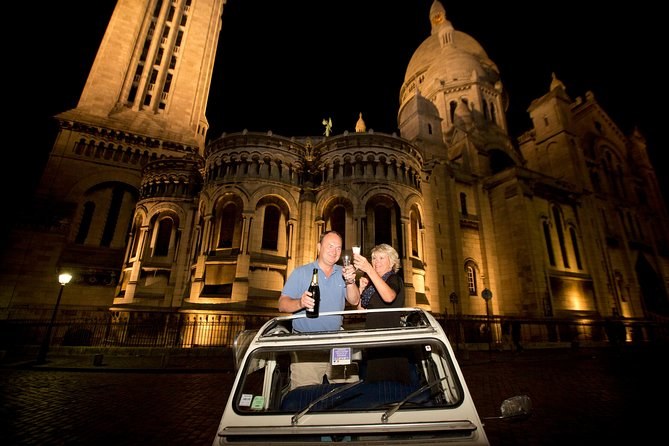
Paris and Montmartre 2CV Tour by Night with Champagne
Per carChampagnePickup offered
Does the whole loop including the climb to Montmartre, and takes you back to your own door afterwards.
From $336 per group of up to 3
Whenever the sun goes down, which in Paris is a moving target. Sunset runs from about 16:55 in the third week of December to about 21:55 in the third week of June, with full dark roughly thirty-five minutes later. Everything below is written against dusk rather than against a clock, so it works in either season.
Look up your own date on our sunset times page, then read the plan below with that hour as the starting gun. In December you will be finishing before nine; in June you will be starting at nine.
Because the twenty to forty minutes right after sunset are the best light of the whole evening. Trocadéro is the best place to spend them. The esplanade between the two wings of the Palais de Chaillot is elevated, faces the Eiffel Tower squarely across the river, and has the fountains running below.
What you get in that window is a sky that still holds colour and a tower that is already lit. Photographers call it the blue hour and at this latitude it is much shorter than an hour, which is why it is worth being in position rather than walking towards it.
Getting there: Trocadéro on lines 6 and 9, and the exit puts you on the esplanade. Time to allow: thirty minutes.
The tower sparkles. Twenty thousand six-watt bulbs on its four sides fire in short random bursts for exactly five minutes at the beginning of every hour, from dusk until midnight or 1am depending on the season.
You can watch it from Trocadéro, which is the postcard, or walk down and across the Pont d'Iéna to the Champ de Mars and watch it from directly underneath, which is the better experience and the worse photograph. Either way, be in position five minutes early.
Time to allow: fifteen minutes at Trocadéro, or forty if you cross and stand beneath it.
East along the river. The stretch from the Pont d'Iéna to the Île de la Cité takes in Pont Alexandre III, the Grand Palais and the Musée d'Orsay. It is the single best walk in the city after dark. It is also about forty minutes on foot, which is where a booked departure starts earning its money.
If you are walking, take the right bank as far as the Pont Alexandre III, cross it for the gilded lamps, then continue along the left bank past the Orsay. If you are in a car or on a bike, this is the section where the driver will offer to stop.
Forty minutes is enough and an hour is better. Notre-Dame's west front is floodlit and entry is free. On Thursdays the cathedral stays open until 22:00, the only night of the week you can be inside it after dark, with last entry at 21:30.
Behind it, the Square Jean XXIII gives you the apse and the flying buttresses lit from below with almost nobody there, and the quays of the Île Saint-Louis are the quietest part of central Paris at any hour. This whole stretch of river has been a UNESCO World Heritage Site since December 1991.
Yes, if you watch the clock. Sacré-Cœur closes at 22:30 every day of the year and admission is free, so the question is simply whether you can get there in time. From the islands it is about twenty-five minutes by métro, or fifteen in a car.
In winter that is easy: you will have started at five and have hours in hand. In June, starting at nine, it is tight. Either skip the islands or accept the basilica from outside. The funicular saves the climb from Anvers.
| Time | Where | What happens |
|---|---|---|
| 21:00 | Trocadéro | The blue hour. Sky still coloured, tower already lit |
| 22:00 | Champ de Mars or Trocadéro | The sparkle, five minutes |
| 22:20 | Pont Alexandre III | The lamps, and the reflection from the quay |
| 23:00 | Île de la Cité | Notre-Dame floodlit; the cathedral itself is shut |
| 23:40 | Montmartre | Sacré-Cœur from outside; the basilica closed at 22:30 |
| 00:30 | Métro home | Last trains from about 01:15, later at weekends |
| Time | Where | What happens |
|---|---|---|
| 17:00 | Trocadéro | The blue hour, four hours earlier than in June |
| 18:00 | Champ de Mars | The first sparkle of the night |
| 18:30 | Pont Alexandre III | The lamps, with the quays almost empty |
| 19:15 | Île de la Cité | Notre-Dame — and on a Thursday you can go in |
| 20:30 | Montmartre | Inside Sacré-Cœur, free, with two hours to spare |
| 22:00 | Dinner | Everything is still open and you have your evening back |
The winter plan is the better one and almost nobody books it. Eight hours of lit city against four, the monuments at their emptiest, and the Christmas lights on the Champs-Élysées from late November.
The connections. The sights are free and the distances are not: Trocadéro to the islands is forty minutes on foot, and the islands to Montmartre is another twenty-five by métro. A vehicle collapses both into a few minutes and stops where the views are.
That is the honest case for a booked departure on this itinerary: not access, which is free, but time. Our night tour options page sets out which formats stop and which simply pass.
The métro runs to roughly 01:15 on weeknights and about 02:15 on Friday and Saturday nights, with last departures around 01:40. After that, 47 Noctilien night bus lines run from 00:30 to 05:30 through Châtelet, Montparnasse, Gare de l'Est, Gare Saint-Lazare and Gare de Lyon.
Times differ by station, so check your own rather than the network average. If you have booked a private car or a 2CV, this question does not arise: they take you back to the address they collected you from.
Then cut it to two stops rather than rushing five. The strongest short version is Trocadéro in the blue hour and the sparkle on the hour, then one river crossing on foot to the Champ de Mars. That is ninety minutes and it is the part everyone remembers anyway.
The second-strongest is a seventy-minute cruise timed to sail after dark, which gives you the whole river stretch without walking any of it. At nineteen dollars it is the cheapest way to compress this itinerary, and our boat tours page covers which sailing to take.
Depends which half you are on. Around the Champ de Mars the Rue Saint-Dominique and the Rue Cler are the local answer rather than the tourist one, and both are a short walk from the tower. On the islands, the Île Saint-Louis has cafes open late along the Rue Saint-Louis-en-l'Île.
In Montmartre the streets behind the basilica keep going long after the crowds have gone down the hill. If you would rather have the meal built into the evening, the dinner cruise and the Moulin Rouge both solve it, at the cost of fixing your timing to theirs.
Yes, and the winter version is the one to use. Dark by 17:30 in December means the whole thing happens before a reasonable bedtime, which is impossible in June when the first sparkle is at 22:00.
Cut the walking and keep the stops. A golf cart or an open-top bus covers the ground without asking anybody to walk forty minutes along a quay, and the age rules on those are the loosest in the list. The segway will not take under-twelves and the bike tour sets a minimum age of fourteen for its e-bikes, so neither belongs in a family evening.
West to east, always. Starting at Trocadéro and finishing in Montmartre puts the best light at the beginning, when the sky still has colour in it, and leaves the two free interiors for the end when you want to be indoors and warm.
Reversing it wastes the blue hour on a basilica you can see perfectly well at ten o'clock, and puts you at the Eiffel Tower at midnight when the last sparkle has already happened. The order matters more on this itinerary than the individual stops do.
Nothing, if you walk it and go inside only the free buildings. Two métro tickets and a pair of comfortable shoes. That is a real evening and it is worth saying so.
Add a booked departure for the connections and it runs from nineteen dollars for a seventy-minute cruise to a few hundred for a private car that does the whole loop with you. Everything, with its price basis and its refund terms, sits on Paris Night Tours.
Does the whole loop including the climb to Montmartre, and takes you back to your own door afterwards.
From $336 per group of up to 3

Covers the same circuit in two hours from a single stop, with the departure moved seasonally to follow the sunset.
From $33 per person
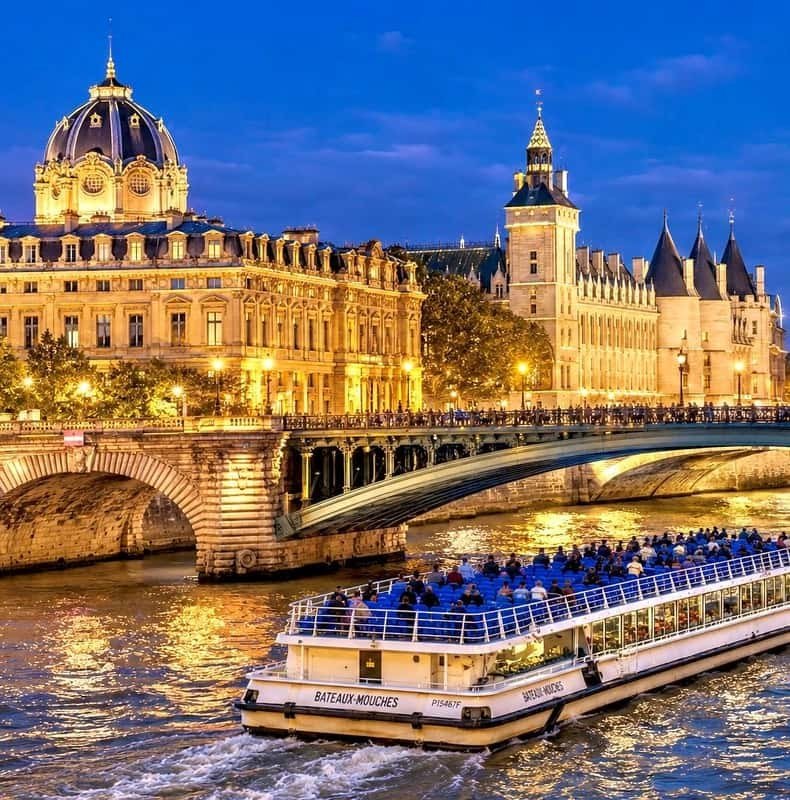
The river half of this itinerary in seventy minutes, sailing every thirty minutes from five in the afternoon.
From $19 per person
This one is sold non-refundable — the rest cancel free up to 24 hours ahead.
Not sure which format should carry the connections? Which Paris night tour is right for you compares all seven.