
Paris Big Bus Open Top Panoramic Night Tour
Open topGuided
Thirty-three dollars for fourteen landmarks and recorded commentary, which is the cheapest way to stop guessing what you are looking at.
From $33 per person
Better than most people assume. Paris lights around three hundred buildings and bridges every night and charges nothing to look at any of them. The Eiffel Tower sparkles for five minutes on the hour whether or not you have bought anything, and you can watch it from Trocadéro, the Champ de Mars or half the bridges in the centre.
Two of the best interiors in the city are also free after dark. Sacré-Cœur is open until 22:30 every day of the year with no admission charge, and Notre-Dame is free every day and open until 22:00 on Thursdays. Neither of those is a consolation prize.
Three things, and it is worth being precise about them because only one is usually mentioned.
The distance. Trocadéro to the islands is forty minutes on foot. The islands to Montmartre is twenty-five more by métro. On one evening those gaps eat the evening; a vehicle collapses them into minutes and stops where the views are.
The time. A booked departure fixes the hour, which sounds trivial until you have spent an evening deciding. It also fixes it at the right hour, because the operators run their departures after dark.
The talking. Not on all of them — two of the three cruises have no guide at all — but on most, somebody is naming what you are looking at and answering questions.
| Evening | What you pay | What you get |
|---|---|---|
| Walk it yourself | 2 métro tickets | Every lit exterior, plus two free interiors |
| Seventy-minute cruise | From $19 | The river angle, warm, no commentary |
| Open-top bus | From $33 | Fourteen landmarks in two hours, with commentary |
| Guided walk | From $64 | The same streets, with somebody explaining them |
| Private car | From $155 | The whole loop, warm, with stops and a door-to-door run |
| Vintage 2CV | From $336 per car | The loop, plus the car being part of the evening |
The interesting row is the third. At thirty-three dollars the open-top bus costs less than dinner and removes the two things that make the free version hard: the walking and the not knowing what you are looking at.
Anyone staying a week. If you have six evenings in Paris, spend one of them walking the river and one of them in Montmartre and you will have seen more, for nothing, than any two-hour departure covers. The city is safe, well lit and easy to navigate after dark.
Anyone travelling with a Paris regular, for the obvious reason. And anyone whose real interest is photography — a tour moves when you want to stay, and the good light is a twenty-minute window that no schedule respects.
If you have one evening, book something. The gaps between the sights are the problem and a vehicle solves them. If you are arriving that afternoon, book something, because deciding is the last thing you want to do at 8pm in a city you do not know.
If somebody in your party cannot walk far, book a private car or a cruise. If you are on your own and would rather not be, a small-group walk or the segway tour puts you with people. And if the evening is an occasion, book the thing that makes it one.
For this subject, usually. Almost everything you came to see is outdoors and free, so a ticket is not what is scarce here — unlike a museum, where a skip-the-line ticket solves a real problem. What is scarce is the route and the timing.
The exception is the Louvre. The private evening tour includes a timed entry ticket and takes you into the museum on one of its late-opening nights, which is a genuinely different proposition from looking at the pyramid from the courtyard.
Directly from whichever platform the operator sells through, which is what every booking link here does. The price is the operator's own and it is the same whether you arrive through a guide like this one or go to the platform yourself.
What a comparison saves you is the reading. A long list of listings with different price bases, different group caps, different cancellation terms and different meeting points is an hour of tabs. Every night time paris tours option is on one page with those four things stated on each card.
Sacré-Cœur is, without qualification. It sits on the highest natural point in Paris, it is floodlit white and visible from most of the city, and it is open until 22:30 every day of the year for nothing. Going inside it late, with the city below you on the way out, is one of the better things you can do in Paris at any hour.
Notre-Dame is worth planning a Thursday around if your dates allow. Free, open until 22:00, last entry 21:30, and reopened in December 2024. Our page on what stays open has both, with the rest of the late hours.
Access, mostly. Almost every departure here is an exterior tour and one listing says so in exactly those words. You are not skipping a queue, because there is no queue; you are not getting in anywhere, because nothing on the route requires a ticket.
It also does not get you the good light unless you book the right hour. That is on you, and our sunset times page is the fastest way to get it right.
Central Paris after dark is busy, well lit and heavily policed, and the areas this evening covers are among the safest parts of the city. Thousands of people walk the same quays every night.
The precautions are the ordinary urban ones. Keep a phone out of an open pocket on the métro and around the Champs-Élysées, where pickpocketing is the real risk rather than anything worse. Do not walk a long distance alone once the trains have stopped; take a taxi or a ride app instead.
For a solo traveller, the company is a genuine part of what a guided departure buys, and it is a better reason than most of the ones operators advertise.
Answers to the question you actually have. A recorded commentary tells everybody the same thing in the same order; a live guide tells you why the Pont Alexandre III has winged horses on it because you asked.
The honest counterweight is that two of the three cruises have no guide at all, and several thousand people rate them highly anyway. If your interest is the view rather than the history, you are not missing much, and the fifteen dollars between a guided and an unguided cruise is better spent on the later sailing.
It changes the calculation towards booking, and towards winter. The distances are the problem with a self-guided evening and children feel them first; a vehicle removes that entirely.
The other change is the clock. In December the whole lit evening happens between 17:30 and 20:00, which fits a bedtime. In June nothing is lit until 22:40, which does not. If you are travelling with young children and want them to see this at all, go in winter.
If photographs are the point, a tour is usually the wrong purchase. The good light is a twenty to forty minute window after sunset and no schedule respects it, and the best shots need you to stand in one place for longer than a group will wait.
Book a walking tour if you want somebody to show you where to stand, then go back alone the following evening and use what you learned. The bridges are the reason: Pont Alexandre III for the lamps, the Pont de Bir-Hakeim for the tower, and the Pont de la Tournelle for Notre-Dame lit from below. All three are free, and all three are better with a tripod that no tour will let you carry.
Not for the price. The figure is the operator's own and it is identical whether you reach it through a comparison like this one or go to the booking platform directly. What differs is the cancellation handling and how quickly a question gets answered, and both of those belong to the platform rather than to the operator.
What is worth checking on any listing before you commit is the refund window, the group cap and the price basis, because those three vary more between these eighteen products than the price does.
If you have several evenings and reasonable legs, walk it, and put the money towards dinner. If you have one evening, book something cheap and continuous — the cruise or the bus — and use it to find out what you want to come back to.
Book something expensive only when the evening itself is the occasion, which is a real reason and not a marketing one. The decision guide works through which format fits which of those cases, and Paris Night Tours carries the prices, the group caps and the refund terms for every one of them.
Thirty-three dollars for fourteen landmarks and recorded commentary, which is the cheapest way to stop guessing what you are looking at.
From $33 per person
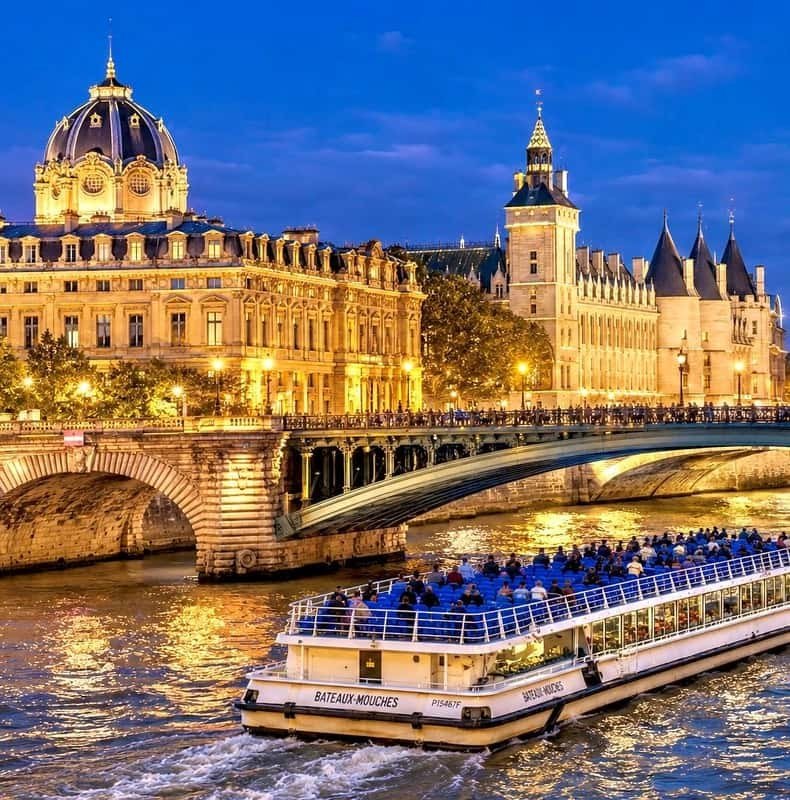
Nineteen dollars for the river angle you cannot get from any pavement, sailing every half hour from five.
From $19 per person
This one is sold non-refundable — the rest cancel free up to 24 hours ahead.
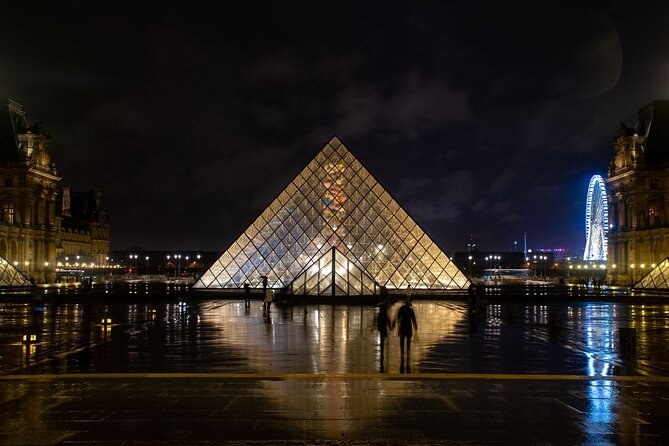
The free walk with somebody explaining it, in a group that caps at eight, for sixty-four dollars.
From $64 per person
If the answer is yes, the decision guide narrows seven formats to one in about two minutes.