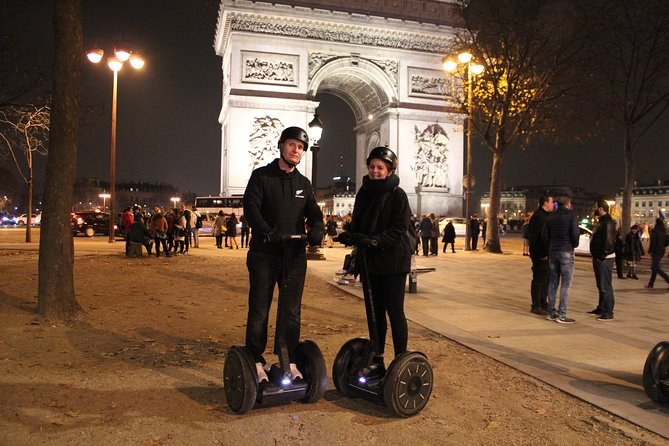
Paris by Night: Exclusive Segway night tour with a Local Guide
Helmet providedGuidedUp to 15
Ninety minutes with a local guide who stops wherever the photograph is, finishing under the tower in time for the sparkle.
From $76 per person
Not approximately five. The lights fire in short random bursts at the beginning of every hour and stop after five minutes, on a timer. The effect was designed to look like camera flashes going off across the whole structure.
The sparkle was switched on for the first time on 31 December 1999, to welcome the year 2000. In 2008 the duration was halved to five minutes, to cut energy use and extend the life of the installation.
It also took 40 kilometres of string lights and power cables, 40,000 clamps, 80,000 miscellaneous metal parts weighing 60 tonnes in total, and 230 electrical cabinets. All of it was fitted to a structure that was already 110 years old.
At the 1am sparkle the golden floodlighting and the beacons are switched off first. For those five minutes the tower is nothing but the flashing against a black sky, which is a completely different photograph from the one everybody else takes at 9pm.
Four marine-type projectors, one on each side of the summit, come on at dusk. On a clear evening the rays carry up to 80 km — further than the distance from Paris to Reims.
The golden lighting is triggered by twilight sensors and comes on within ten minutes of it getting dark, whatever the date. That is why the tower is lit at 17:10 in December and at 21:55 in June without anybody adjusting a timetable.
From about 16:55 around the winter solstice to about 21:55 around the summer one. Paris is at 48.9°N, further north than Montreal, Vancouver or every city in the continental United States.
"Paris, Banks of the Seine" was inscribed on the UNESCO World Heritage List in December 1991. The property runs from the Pont de Sully to the Pont d'Iéna and takes in the Île de la Cité, the Île Saint-Louis, the quays and the bridges — which is the exact stretch a night cruise covers.
Every day, without exception, including Christmas Day. It is on the highest natural point in the city and it costs nothing, which makes it the single best-value thing to do in Paris after dark.
The cathedral reopened in December 2024. Entry is free every day, and Thursday is the one evening of the week you can be inside it after dark, with last entry at 21:30.
The Louvre runs to 21:00 on those two evenings and closes entirely on Tuesdays. Last admission is an hour before closing, so the real cut-off is 20:00 — and the late slots are noticeably quieter than any daytime hour.
Its only late night runs to 21:45, and the evening ticket from 18:00 costs €12 against €16 online during the day. Last admission is 21:00.
The Moulin Rouge opened in the same year as the Eiffel Tower. Its current revue is called Féerie and runs twice a night, at 21:00 and 23:00, with dinner served from 19:00. Smart dress is required and the minimum age is six.
The open-top night tour leaves at 21:30 from 30 March to 27 September and at 20:30 from 28 September onwards. It is the only tour in the list that publicly moves its clock to follow the sunset, and it is a good sign about the operator that it does.
| Fact | The figure | Where it comes from |
|---|---|---|
| Sparkle duration | 5 minutes, on the hour | Official Eiffel Tower site |
| Sparkle bulbs | 20,000 at 6 watts | Official Eiffel Tower site |
| Beacon range | Up to 80 km | Official Eiffel Tower site |
| UNESCO inscription | December 1991 | UNESCO World Heritage List, no. 600 |
| Sacré-Cœur hours | 06:30 – 22:30, free | The basilica's own site |
| Sunset range | 16:55 – 21:55 | Computed for central Paris |
Put two of the figures above together and a booking strategy falls out of them. The lighting follows the sensors rather than the clock, and the sun sets at 16:55 around the winter solstice. That means a December evening carries roughly eight hours of illuminated city, against about four in June.
December is also when the Champs-Élysées and Place Vendôme are strung with Christmas lights, when the monuments are at their emptiest, and when a seventy-minute cruise leaving at 18:00 is already sailing in the dark. The cost is the cold, which a coat solves. Almost nobody books it, and that is the arbitrage.
The Catacombs close in the evening. There is no catacombs night tour to book, whatever a search result suggests, and the same is true of a night helicopter flight over the centre — sightseeing flights do not run over Paris after dark. Both queries have volume and neither has a product behind it.
What does exist, and what people are usually reaching for when they search either phrase, is the lit exterior circuit: the bridges, the floodlit facades and the sparkle on the hour. That is what every departure here actually sells.
Two of these facts change how you should book. The sunset range decides your departure time, and the sparkle schedule decides where you want to be on the hour. Our sunset times page handles the first and our what to see page handles the second.
The rest are simply worth knowing while you are standing there. If you would rather somebody told you them on the night, most of the guided departures on Paris Night Tours include a live guide rather than a recording, and the options page says which.
Ninety minutes with a local guide who stops wherever the photograph is, finishing under the tower in time for the sparkle.
From $76 per person
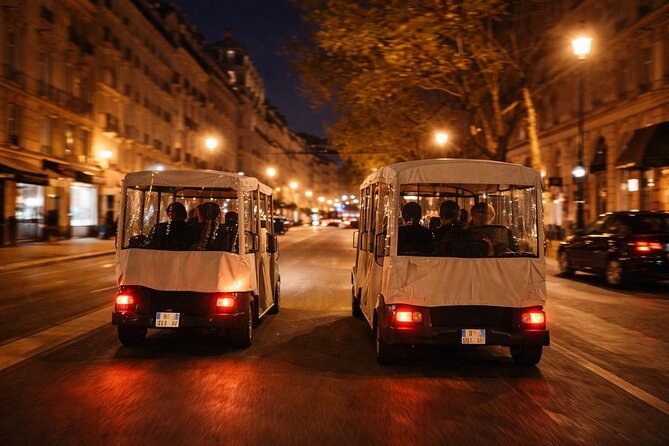
An open electric cart, private to your party, with a driver who narrates and parks where a coach never could.
From $177 per person
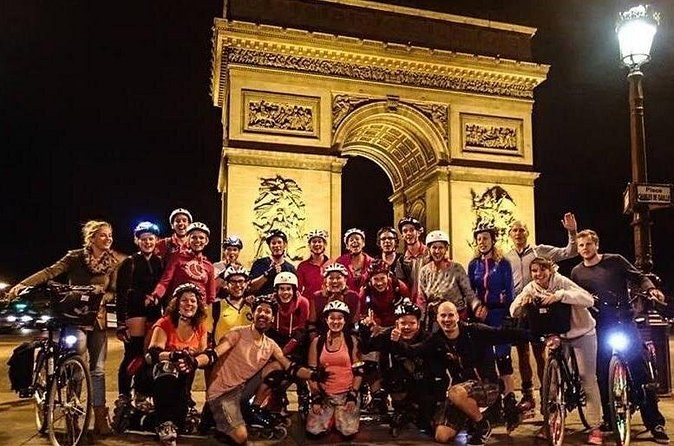
Three hours and a guide who knows the history of the streets you are riding through, with the bicycle included.
From $53 per person
If the sparkle is the fact you care about, the one-night itinerary puts you in front of it at the right minute.