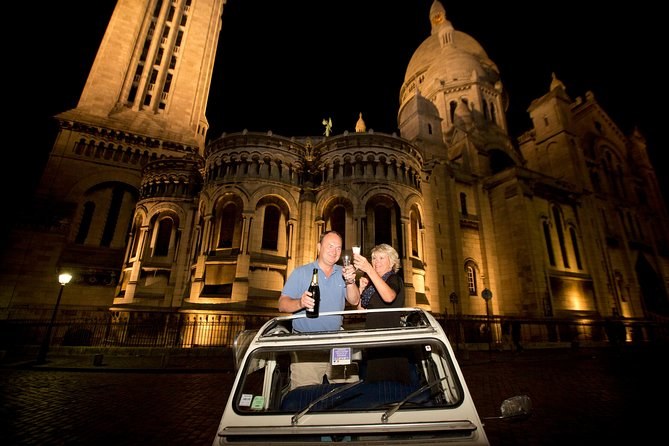
Paris and Montmartre 2CV Tour by Night with Champagne
Per carChampagnePickup offered
The Eiffel Tower, Notre-Dame, the Arc de Triomphe and the climb to Montmartre, in an open-top car with champagne.
From $336 per group of up to 3
The golden lighting switches on automatically within ten minutes of dusk, triggered by twilight sensors. Then, at the beginning of every hour, 20,000 bulbs on the four sides fire in random bursts for exactly five minutes. That is the sparkle, and it runs until midnight or 1am depending on the season.
The best vantage point is the Trocadéro terrace across the river, which is elevated and square-on. The Champ de Mars puts the tower filling the sky. The Pont de Bir-Hakeim gives you the shot nobody else in your party will have.
Timing: be in position five minutes before the hour. Going up: open daily until 23:00.
Floodlit amber in the middle of twelve converging avenues, which is exactly why the long-exposure photographs work — traffic draws light trails at it from every direction. Reach the central island by the pedestrian tunnel and never across the road.
The terrace on top is open until 23:00 from April to September and 22:30 the rest of the year, with last admission 45 minutes before closing. It is the one high viewpoint in Paris that puts the Eiffel Tower in your picture, and at €16 in winter it is cheaper than the tower itself.
The esplanade between the two wings of the Palais de Chaillot, and the most photographed spot in the city after dark. Elevated, facing the tower squarely, with the fountains running below. Almost every driving tour stops here.
Timing: the twenty minutes after sunset, when colour is still in the sky and the lighting is already on. That is the blue hour, and at this latitude it is far shorter than an hour.
The most ornate bridge in Paris: gilded candelabra lamps, winged horses at each corner, Les Invalides at one end and the Grand Palais at the other. The lamps themselves are the subject rather than the view through them.
Stand on the bridge for the lamps and on the quay below for the reflection. Unlike most of this list it is unaffected by season, so it works equally well in January.
The basilica occupies the highest natural point in Paris and is floodlit white, so you can see it from most of the city. It is open 06:30 to 22:30 every day of the year and costs nothing, which makes it one of very few Paris interiors you can walk into late.
The steps below look south over the whole city, and the funicular saves the climb. The quarter behind it — Place du Tertre, the vineyard, the streets that fall away from the summit — is worth an hour on its own.
The cathedral reopened in December 2024 and its west front is floodlit again. Entry is free, and on Thursdays it stays open until 22:00, which is the only evening of the week you can be inside it after dark.
The Seine between the Pont de Sully and the Pont d'Iéna was inscribed on the UNESCO World Heritage List in December 1991, along with the Île de la Cité and the Île Saint-Louis. That is the exact stretch every river cruise sails, which is a better argument for taking one than any operator makes.
Two very different kinds of light, and both on almost every driving route. The opera house is floodlit stone with a gilded roof at the end of a boulevard that hands you the light trails. The Moulin Rouge is a red neon windmill on the Boulevard de Clichy that has been turning since 1889.
Neither needs a ticket to enjoy from the pavement. If you want to be inside the Moulin Rouge, the Féerie revue runs at 21:00 and 23:00 with dinner from 19:00, and our page on what stays open has the dress code and the age limit.
Most of the list falls on a single loop. A car covers it in about two hours and a cruise covers half of it from the water. The order that works is Trocadéro for the blue hour, the tower for the sparkle on the hour, along the river to the islands, then up to Montmartre before the basilica closes at 22:30.
| Landmark | Where to stand | When it is best | Free? |
|---|---|---|---|
| Eiffel Tower | Trocadéro or Pont de Bir-Hakeim | 5 min before any hour | Yes, from outside |
| Arc de Triomphe | The central island, via the tunnel | After full dark | Outside yes, terrace €16–22 |
| Trocadéro | The esplanade | The blue hour | Yes |
| Pont Alexandre III | On the bridge, or the quay | Any evening | Yes |
| Sacré-Cœur | The steps below | Before 22:30 to go in | Yes |
| Notre-Dame | Square Jean XXIII | Thursdays to 22:00 | Yes |
| Palais Garnier | Place de l'Opéra | After full dark | Yes, from outside |
| Moulin Rouge | The pavement opposite | From dusk | Yes, from outside |
Full detail on each, with the practicalities, sits on our what to see after dark page, and the one-night itinerary guide turns the loop into an evening with times against it.
More than you expect. A modern night mode holds three to five seconds, which is enough for any floodlit facade and hopeless from a moving vehicle. Brace the phone on a railing, shoot the sparkle as video, and take the wide shots from Trocadéro where you have somewhere solid to rest it.
Every landmark above appears on at least one departure listed on Paris Night Tours. If you want the tower specifically, the paris night tour eiffel tower routes all finish there.
The Eiffel Tower, Notre-Dame, the Arc de Triomphe and the climb to Montmartre, in an open-top car with champagne.
From $336 per group of up to 3
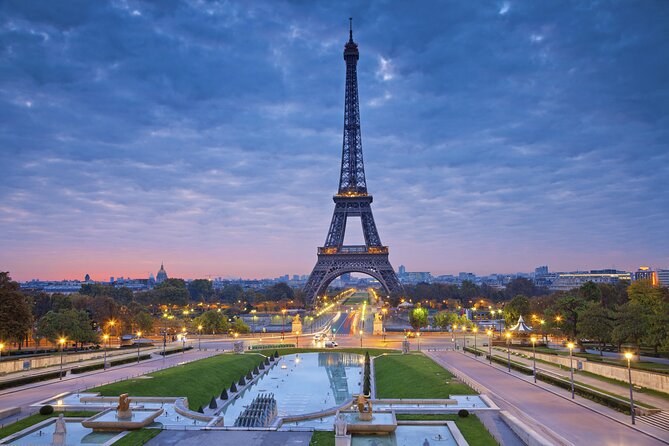
Eight exterior stops in three hours with twenty to thirty minutes at each, collected from your hotel door.
From $194 per person
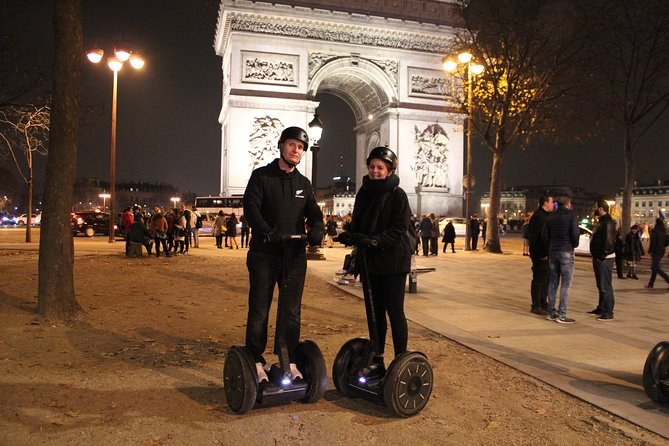
Les Invalides, Pont Alexandre III, the Louvre courtyards and the Champ de Mars in ninety minutes on two wheels.
From $76 per person
Want the evening planned rather than listed? One night in Paris, sunset to the last métro puts times against every stop above.